

For decades, gamblers have asked the same question: Is the game really fair?
Whether someone is spinning a slot machine, placing a sports bet, or playing blackjack online, the result appears within seconds. The reels stop. The cards appear. The wheel lands on a number.
But behind the scenes, players rarely see how those results are produced.
Because of that, skepticism has always existed in the gambling world. Some players wonder whether casinos secretly influence results. Others suspect that software might change odds behind the scenes.
This debate has existed for generations, from the earliest slot machines in the late 1800s to modern online casinos.
Now a new technology is entering the conversation: blockchain.
Supporters believe blockchain could make gambling more transparent and verifiable than ever before. Critics say it still cannot solve every trust issue.
So the real question is simple:
Can blockchain actually make gambling fair?
To understand that, we need to look at how blockchain works and how it is being used in modern gambling platforms.
Understanding Blockchain in Simple Terms

At its core, blockchain is a digital record system that stores information across many computers instead of one central server.
Think of it like a giant public ledger that records every transaction permanently.
Once information is recorded in this ledger, it becomes extremely difficult to change. Every new entry connects to the previous one, creating a chain of records. That is why the technology is called a blockchain.
In gambling platforms that use blockchain, important events can be recorded such as:
- Bets placed by players
- Game results
- Payment transactions
- Payout confirmations
Because the information is shared across many computers in a network, no single company can secretly modify the records.
This transparency is one of the main reasons blockchain is attracting attention in the gambling industry.
According to a 2024 industry report, the global blockchain gaming market is expected to exceed 65 billion dollars by 2027, with gambling platforms representing a significant part of that growth.
Projected Growth Graph (2020–2027)
Market Size (USD Billions)70B |                                   █
65B |                                   █ 2027
60B |                                 █
50B |                              █
40B |                           █
30B |                        █
20B |                    █
10B |              █
 5B |          █
 3B |       █
 1B |    █
     ------------------------------------------------
      2020 2021 2022 2023 2024 2025 2026 2027
Approximate market trajectory
| Year | Market Size (USD) |
|---|---|
| 2020 | ~$1B |
| 2021 | ~$2B |
| 2022 | ~$4.6B |
| 2023 | ~$8B |
| 2024 | ~$14B |
| 2025 | ~$25B |
| 2026 | ~$40B |
| 2027 | ~$65B |
Supporters believe that blockchain could solve one of the biggest problems gamblers worry about: trust.
The Concept of Provably Fair Gambling
One of the most important ideas in blockchain gambling is something called provably fair gaming.
Traditional online casinos often use Random Number Generators (RNGs) to determine results. These systems are tested by independent auditors, but players usually cannot verify each result themselves.
Blockchain systems attempt to change that.
In a provably fair system, the randomness behind a game can be verified by the player after the result appears.
Here is how it typically works:
- The casino generates a secret random value before the game starts.
- The player contributes another value, often automatically through their device.
- Both values combine to generate the final result.
- The blockchain records the process so the player can check it later.
This process means the casino cannot change the result after the bet is placed.
If someone wants to verify the outcome, they can examine the recorded data and confirm that the result was generated fairly.
A software developer who works in blockchain gaming once explained it this way:
“Provably fair systems remove the need to trust the casino. Instead, players can verify the math themselves.”
This level of transparency is one of the biggest innovations blockchain brings to gambling.
Blockchain Payments and Faster Payouts
Another major advantage of blockchain gambling involves payments.
Traditional online casinos rely on banks, payment processors, and financial institutions to handle deposits and withdrawals. This can sometimes create delays.
Players often report waiting hours or even days to receive winnings.
Blockchain payments work differently.
Instead of going through a bank, funds move directly between digital wallets using cryptocurrencies.
This creates several advantages:
- Transactions can be processed within minutes
- Payments are recorded publicly on the blockchain
- Platforms cannot easily reverse or block legitimate payouts
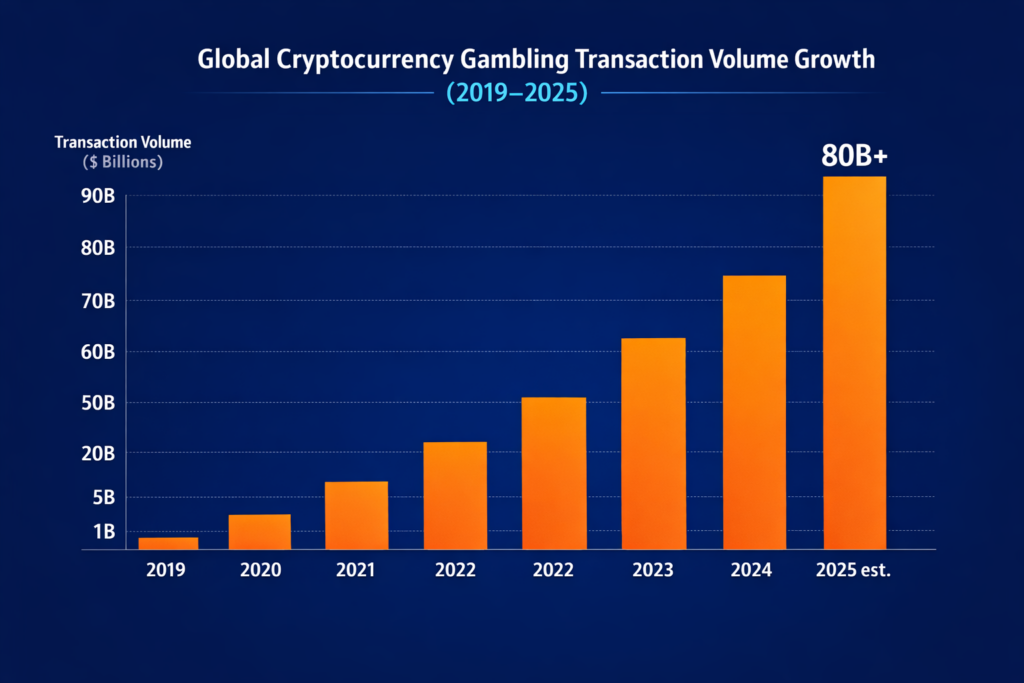
According to blockchain analytics firms, cryptocurrency gambling transactions exceed 250 billion dollars annually worldwide.
Graph: global cryptocurrency gambling transaction volume growth from 2019 to 2025
Many players appreciate the speed and transparency of these payments.
One gambler wrote in an online discussion forum:
“With crypto casinos I can see the transaction on the blockchain. That gives me more confidence the payment is real.”
Another user shared a similar experience:
“Withdrawals used to take two days on some sites. With crypto it shows up in my wallet almost instantly.”
These comments highlight why blockchain payments are becoming increasingly popular among online gamblers.
Real World Examples of Blockchain Gambling Platforms
Over the past decade, several platforms have experimented with blockchain gambling.
Some offer fully decentralized casinos, where smart contracts automatically handle bets and payouts.
Others combine traditional online casino features with blockchain transparency tools.
Common blockchain gambling games include:
- Dice games with provably fair verification
- Blockchain based poker rooms
- Crypto powered slot machines
- Sports betting platforms using smart contracts
One popular blockchain dice game reportedly processed millions of bets per month during its peak activity.
These platforms attract players who value transparency and cryptocurrency payments.
However, they still represent a small portion of the overall gambling industry.
The global gambling market generates over 500 billion dollars annually, while blockchain casinos represent only a fraction of that total.
Graph: comparison of traditional gambling market size vs blockchain gambling sector
Even so, the sector is growing quickly as technology improves.
Challenges Blockchain Gambling Still Faces
Despite its potential benefits, blockchain gambling also faces several serious challenges.
1. Complexity for New Users
Many people still find blockchain technology confusing.
Players must understand things like:
- digital wallets
- private keys
- cryptocurrency transactions
If someone loses access to their wallet or forgets their password, recovering funds can be extremely difficult.
This complexity can discourage casual gamblers.
2. Government Regulation
Gambling laws vary widely across different countries.
Many governments regulate casinos strictly to prevent fraud, protect consumers, and reduce illegal activity.
Blockchain platforms often operate across international borders, making regulation more complicated.
Some countries have not yet created clear laws for cryptocurrency based gambling services.
This legal uncertainty can slow industry growth.
3. Software Still Matters
Even though blockchain records results, the games themselves are still created by developers.
If a game is designed poorly or unfairly from the start, blockchain alone cannot fix it.
This means players still need to trust that the platform has built fair game logic.
Blockchain increases transparency, but it does not eliminate the importance of good software design.
4. Network Speed and Fees
Blockchain networks sometimes struggle with transaction speed and fees.
During busy periods, some networks charge higher processing costs.
For fast paced gambling environments where players place many bets quickly, these delays can affect the experience.
Developers are working on new technologies to improve speed and reduce costs.
What Experts Say About Blockchain Gambling
Many technology experts believe blockchain has strong potential but still needs time to mature.
A blockchain gaming researcher once explained:
“Transparency is the biggest advantage blockchain offers gambling. But user experience and regulation still need improvement.”
Another analyst from a digital gaming consultancy shared a similar view:
“Provably fair systems are a huge step forward. However, mainstream adoption will require simpler platforms for everyday players.”
These perspectives show that the technology is promising but still evolving.
Final Thoughts
Gambling has always involved two powerful forces: luck and trust.
Players accept the role of chance in every game. But they also want to know that the system itself is fair.
Blockchain technology introduces a new way to build that trust.
By recording game results on transparent networks and allowing players to verify outcomes themselves, blockchain offers something traditional gambling systems often lack: visible proof.
At the same time, the technology is still developing.
Challenges involving usability, regulation, and software design remain important issues.
The future of gambling may include a mix of systems:
- traditional casinos
- regulated online platforms
- blockchain based gaming networks
Each approach will likely continue improving over time.
But the goal remains the same.
Players want fairness.
Casinos want credibility.
Regulators want safety.
If blockchain can help balance those three things, it could become one of the most important technological shifts the gambling industry has ever seen.
And as more players begin exploring provably fair systems, the long standing question about casino fairness may finally start to find clearer answers.