
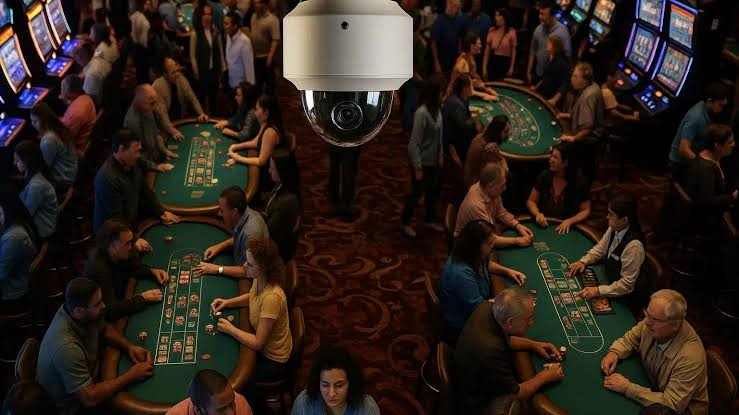
Casino security once depended primarily on people observing activity, patrolling the premises, and responding to incidents as they occurred. Today, many venues combine these traditional responsibilities with digital cameras, access-control systems, alarms, and networked monitoring tools.
This shift is sometimes described as a move from security guards to smart systems. In practice, it is more accurate to view it as an expansion of security capabilities rather than a replacement of people with machines.
Technology can help security teams collect information and coordinate responses, but human judgement remains essential.
Security Before Integrated Digital Systems
Traditional casino security centred on staff presence, physical patrols, communication, and procedures for handling incidents. Employees monitored public areas, supported visitors, managed access to restricted spaces, and responded to emergencies.
These methods depended on training, awareness, and coordination. Staff could interpret behaviour in context, speak directly with visitors, and make decisions based on what they observed.
However, human observation has limits. A large venue may contain many rooms, entrances, corridors, and gaming areas. Staff cannot be physically present everywhere at once, and written reports can take time to collect and review.
Surveillance and electronic monitoring developed partly to support these practical challenges.
The Shift to Centralised Monitoring
Camera systems made it possible to observe multiple areas from a central location. As recording technology improved, security teams could review footage after an incident rather than relying exclusively on immediate observations.
Digital systems made storing and retrieving recordings more practical than some older methods. Network connectivity also enabled different parts of a venue to communicate information to a central monitoring environment.
The exact configuration differs between casinos. Some systems may integrate cameras with alarms or access-control information, while others operate as separate platforms.
Centralised monitoring can improve coordination, but its effectiveness depends on good camera coverage, reliable equipment, appropriate access permissions, and trained operators.
What Makes a Security System “Smart”?
The term smart security can refer to several technologies rather than one specific product. A system may combine digital video, sensors, electronic access records, alerts, and software that helps staff review information.
Some systems use automated video analysis to flag events that may need human attention. Others focus on technical monitoring, such as detecting equipment faults or reporting access events.
These functions vary widely. Automated analysis should not be treated as infallible, and an alert does not necessarily prove that misconduct has occurred. Human review and clear procedures are needed before decisions are made.
A well-designed system should help staff prioritise attention, not encourage them to accept every automated result without question.
Access Control and Digital Records
Electronic credentials can make it easier to manage access to restricted areas. Permissions can be assigned according to job responsibilities and updated when circumstances change.
Digital records may also help investigators establish when a credential was used to enter a particular area. Such records need to be protected and interpreted carefully: a credential log alone does not always establish who physically used it or why.
Good access control combines appropriate technology with staff policies, secure credential management, and periodic review of permissions.
Combining People and Technology
Security systems can gather information, but people are responsible for responding appropriately. Staff need to know how to interpret alerts, communicate with colleagues, assist visitors, and escalate serious incidents.
Training is especially important when new technology is introduced. Employees should understand what a system can and cannot do, how to handle false alarms, and how to protect sensitive information.
A security programme should also include routine maintenance, emergency exercises, incident reporting, and review of procedures after significant events.
Privacy and Responsible Monitoring
As monitoring becomes more sophisticated, privacy and data governance become more important. Video footage, access records, and related information may contain personal data that requires protection.
Casinos need appropriate policies for who can access records, why information is collected, how long it is retained, and when it may be shared. Requirements differ by jurisdiction and by the type of information involved.
Smart technology should be used within clear legal and operational boundaries. More monitoring is not automatically better if it creates unnecessary collection or poorly controlled data.
Conclusion
Casino security has evolved from predominantly guard-led observation into a combination of people, digital surveillance, access controls, automated alerts, and networked systems.
The change allows security teams to monitor more information and coordinate their work, but it also introduces technical, privacy, and reliability challenges. The strongest approach combines appropriate technology with trained staff, clear procedures, and accountable oversight.
FAQs
1. Have smart systems replaced security guards in casinos?
No. Technology supports monitoring and information gathering, while staff remain responsible for many responses, decisions, and interactions.
2. What does smart casino security mean?
It generally refers to digital or connected systems that support surveillance, access management, alarms, and security operations.
3. Can automated security alerts be wrong?
Yes. Systems can produce false positives or miss relevant context, so alerts may need review by trained personnel.
4. Why do privacy controls matter in casino security?
Security systems can collect sensitive information. Access restrictions, retention policies, and compliance with relevant laws help prevent misuse.
One Reply to “From Security Guards to Smart Systems: The Evolution of Casino Security”